Finance Shared Services Solutions
Manage 5, 10, or 500 Entities Without the Complexity
Finance and shared services leaders are under constant pressure to close faster, reduce audit exposure, and deliver real-time insight—while entity complexity grows and headcount does not. When outcomes differ by legal entity, accountability is immediate, visible, and personal.
AMCS by Avantiico, built natively inside Dynamics 365 Finance & Supply Chain Management and validated through Microsoft’s ScaleFast program, provides a proven, low-risk path to governed, repeatable multi-entity control—so every entity produces the same result, every time.
↓90%
Reduction in manual journal work across legal entities
3 – 4
Weeks to go live with a ScaleFast implementation
100s
Of legal entities supported across currencies and regions
Microsoft ScaleFast Validated
Repeatable · Predictable · Faster time to value
The Risks Facing Financial Shared Services Organizations
Multi-Entity Finance Complexity Is Accelerating
Companies running 5 to 50, to hundreds of legal entities across currencies and regions can no longer afford manual reconciliations, late closes, and fragmented reporting. The organizations we work with are navigating many or all of these forces simultaneously — and they need a solution that reduces risk, not adds to it.
Macroeconomic volatility
Forecasting and cash control are harder than ever across entities in shifting markets, making real-time multi-entity consolidation non-negotiable.
Rising regulatory exposure
Fragmented, manual data creates compliance gaps across jurisdictions, and regulators are increasingly scrutinizing multi-entity operations.
Competitors moving faster
Organizations with real-time financial visibility make decisions faster, close earlier, and scale more confidently. The gap is widening.
Multi-Entity Dynamics 365 Support for Leaders
The Pressure Looks Different Depending on Your Role
Whether you’re responsible for the numbers, the operations, or the platform –the complexity of multi-entity management for financial shared services hits differently.
AMCS is designed to equip you with the best multi-entity accounting automation software for Dynamics 365 Finance and Supply Chain Management to address all three to ensure your unique needs are met.
CFOs (Chief Finance Officer)
Close faster. Fewer audit surprises. Consolidated visibility across all entities — so you walk into board meetings with confidence, not anxiety. Stop relying on spreadsheet consolidations to understand performance.
COOs (Chief Operating Officer)
Reduce operational friction. Fewer exceptions, less reactive firefighting, and smoother onboarding of new entities during periods of growth. Shift your team from fixing problems to managing outcomes.
CIOs (Chief Information Officer)
Lower customization footprint. Safer upgrades. Reduced long-term technical debt — with a proven, packaged platform aligned to Microsoft’s ScaleFast program that won’t create tomorrow’s problems.
Multi-Entity Management for Financial Shared Services Built on Deep Expertise
The Gold Standard for Finance Shared Services on Dynamics 365
The Standard for Multi‑Entity Management for Finance Shared Services in Dynamics 365 Finance
Finance shared services organizations don’t lose control because they lack an ERP—they lose it when standardized systems still produce inconsistent outcomes across legal entities.
As shared services scale across regions, currencies, and regulations, entity‑level variance surfaces late: during close, audits, or executive review. This is where multi‑entity management for finance shared services becomes a discipline—not a configuration choice. Avantiico helps enterprises establish governed, repeatable multi‑entity finance operations inside Dynamics 365 Finance & Supply Chain Management.
With AMCS as a standard control layer, leading organizations operate every entity under the same rules—so results scale predictably, without spreadsheets, customization, or new risk. This is how serious shared services organizations maintain confidence at scale.

What Are Multi-Entity Shared Services for Finance & Accounting?
Anyone looking to reduce manual coding effort, improve consistency, and shorten invoice cycle time — without adding headcount.
Multi‑entity shared services for finance and accounting centralize core financial operations, general ledger, intercompany processing, close, and reporting, across multiple legal entities under a single, governed model. The goal of a shared services structure for finance management is standardization at scale: consistent outcomes, predictable processes, and visibility leadership can rely on as entity counts grow.
In reality, many finance shared services organizations implement this structure on top of an ERP like Dynamics 365, yet still face entity‑level variance, manual workarounds, and late‑stage reconciliations. True shared services maturity is defined by whether leaders can trust a single answer across the enterprise and maintain control as complexity increases through growth or M&A.
At Avantiico, we offer tailored end-to-end D365 support and automation for multi-entity enterprises and businesses.
Challenges of Multi-Entity Accounting Automation & Financial Shared Services
Solving the Real Problems Financial Shared Services Team Face
Global companies with shared services for finance & accounting still struggle with fragmented systems and manual processes, even after implementing an ERP. Below are challenges in finance shared services we see consistently that our multi-entity accounting automation helps to solve.
Month-End Close Delays
Intercompany mismatches, late adjustments, and manual rework push close timelines out — creating anxiety before board and audit reviews.
Fragmented Financial Data Across Entities
Disconnected systems and inconsistent reporting create blind spots, making it impossible to get a unified view of global financial health in real time.
Intercompany Mismatches
Cumbersome approval chains and manual reconciliations delay settlements, straining relationships between subsidiaries and increasing audit risk.
Compliance Across Varying Regulations
Ever-changing regional rules and audit demands create compliance headaches across jurisdictions, risking penalties and operational disruptions.
Lack of Real-Time Visibility Across Entities
Finance insight arrives too late to influence decisions. Without real-time consolidated data, leaders are always reacting rather than leading.
Scaling Entity Count without Adding Headcount
As organizations grow — through expansion or M&A — adding legal entities without proportional process automation creates compounding risk.
Avantiico’s Financial Shared Services Solutions
Advanced Multi-Company Solution (AMCS)
↓90%
Reduction in manual journal processing across legal entities
3–4
Weeks to go live via ScaleFast — repeatable, every time
100s
Of legal entities supported across currencies and regions
AMCS’s Core Capabilities
Multi-entity journal automation
Post high‑volume, multi‑entity journal entries once—accurately and consistently—eliminating manual uploads and approval risk.
Automated intercompany reconciliation
Automatically match and eliminate intercompany transactions across entities to enforce real‑time accuracy and consistency.
Exception handling & agent validation
Surface validation issues and exceptions early so problems are resolved before they disrupt close.
Multi-company reporting & trial balance
Generate consolidated trial balance, P&L, and financial reporting across entities without manual aggregation.
Rapid entity onboarding
Add and operationalize new legal entities quickly without increasing finance complexity or overhead.
Third-party system integrations
Extend D365 Finance with native integrations that preserve data integrity across external systems.
The Transformative Power of Multi-Entity Management with AMCS
Before AMCS
Managing by spreadsheet, always a step behind
- Spreadsheet consolidations across entities to understand performance — often days old
- Month-end delayed by intercompany mismatches, late adjustments, and rework
- Financial insight arrives too late to influence decisions or forecasts
- Audit prep creates anxiety — surprises feel inevitable and exposure is real
- Teams spend their day chasing approvals and reconciling discrepancies
After AMCS
Clarity from day one, confidence in every meeting
- Consolidated view across all legal entities — updated automatically, every day
- Agents validate incoming journals and flag exceptions before they become problems
- Month-end close is faster and more predictable, with fewer late adjustments
- Board and leadership discussions backed by timely, trustworthy numbers
- Teams shift from fixing problems to managing outcomes
AMCS Lite
Start with Essential Multi-Entity Automation - Free
AMCS Lite isa free version of the Advanced Multi-Company Solution, offering essential features for multi-entity journal management and basic financial management shared services automation – built natively in Dynamics 365.
- Multi-entity journal transactions
- Data consistency across entities
- Native Dynamics 365 integration
- No customization required
- Fully supported & always free
AMCS Lite vs.
AMCS Premium
Lite
Premium
Feature
Lite
Premium
Automated Super Journal import
Single-click journal validation & posting
Power Automate attachment support
Create multiple legal entities at once
—
Data migration across all entities simultaneously
—
Ledger & budget allocation journals
—
Global intercompany reconciliation
—
Global reporting suite
—
Third-party integrations (ADP, Concur, etc.)
—
Implementation
1-day
self-service
self-service
3-4 weeks
Via ScaleFast
Via ScaleFast
Client Success Stories

“We’re going to be able to remove ourselves from the day-to-day insight building and focus on using that information to develop strategy. We will be able to focus on strategic planning and long-term growth opportunities.”
Nicole Lord, Vice President of Merchandising, Now Optics

"By automating complex, contract-driven billing, we eliminated manual effort, reduced errors, and gained the confidence to scale, while continuing to deliver far more than a traditional 3PL."
Jeff Renaud, VP of Enterprise Applications
"AMCS was implemented in three weeks from installation to production, including training and testing, enabling immediate ROI."
Dan McAllister, D365 Finance Consultant
Ready to Close Faster and Scale Without the Complexity?
Get multi-entity management for finance shared services optimization help today. Request a short working session. We'll validate fit, align on priorities, and identify the best starting point. This is not a commitment to a full project. This is a low-effort way to confirm fit and create a clear path forward.
Loading form...

AMCS Lite | D365 Finance Multi-Company Accounting Automation

Automate Multi-Entity Reporting & Inquiries in Dynamics 365 Finance with AMCS

Automated Microsoft D365 Finance Integrations with AMCS

D365 & AMCS: Elevating Financials with Ledger Allocation Groups
AMCS Lite vs. Premium

Streamlined Multi-Entity Accounting: A Guide to Avantiico’s AMCS for D365 Finance
Streamline Multi-Company Journal Imports in D365 with Avantiico’s Super Journal

New Multi-Company Reporting Features & Limitations in Dynamics 365 Finance 10.0.44/10.0.45
The Best Multi-Entity Accounting Software Platforms in 2025
AMCS Lite for Dynamics 365 F&SCM
Automate Complex Accounting in D365 Finance with AMCS
Streamlining Multi-Entity Accounting Processes & D365 Integrations with AMCS

AMCS Lite: Multi-Company Accounting Automation Webinar in D365 Finance
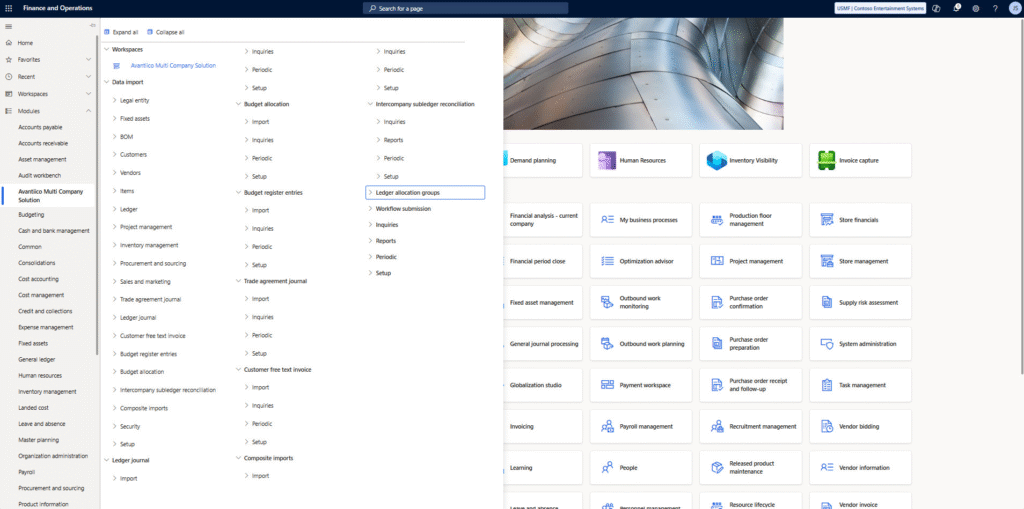
Advanced Multi-Company Solution (AMCS)
FAQs About Multi-Entity Management for Finance Shared Services in D365 F&SCM
Is AMCS Lite really free?
Yes. AMCS Lite is a free entry point designed for organizations still in the evaluation stage before committing to the best accounting platform with multi-entity support inside Dynamics 365. It provides essential multi-entity journal capabilities without customization, allowing teams to reduce manual risk before committing to a broader transformation.
Can you support multiple legal entities across different states and countries?
Yes. We support organizations with multiple legal entities operating across states and countries, ensuring consistent controls, standardized processes, and centralized visibility—without forcing every entity to operate the same way. Our approach allows you to manage local statutory requirements while maintaining global oversight, so leadership always knows where risk, performance, and exposure exist—before issues escalate.
Do you handle multi‑currency accounting and global financial reporting?
Absolutely. We help organizations manage multi‑currency transactions, revaluations, eliminations, and consolidated reporting directly in D365 F&SCM—reducing manual work and exchange‑rate risk. This ensures currency volatility doesn’t distort your close, your reporting, or your credibility with leadership, auditors, or stakeholders.
How do you prevent complexity from getting out of control as we scale?
We design your multi‑entity framework to scale intentionally—standardizing where it matters most while preserving flexibility where it’s required. As you grow, this prevents fragmented data, inconsistent reporting, and last‑minute firefighting—so finance stays in control even as the organization expands.
How do I know if I need AMCS Lite, Basic, Advanced, or Premium?
Choosing between editions depends on scale, risk exposure, and governance needs. Organizations evaluating the best D365 accounting platforms multi-entity support in 2026 typically start with Lite, then expand to Basic, Advanced, or Premium as entity count, audit pressure, and automation requirements increase.
How do I find Microsoft Dynamics 365 Financial Shared Services Partners?
The best way to find Microsoft Dynamics 365 Financial Shared Services Partners is to look beyond general ERP implementation credentials and focus on proven shared services expertise. Strong partners combine deep Dynamics 365 finance knowledge with repeatable, ScaleFast‑aligned solutions that reduce customization and post‑go‑live risk. Providers that deliver established platforms like AMCS demonstrate the ability to support shared services finance models at enterprise scale, without introducing new operational exposure.